For a dry, flaky scalp, a light plant oil — coconut, sweet almond, or a blend with a little kalonji — massaged in once or twice a week and washed out after 1–2 hours usually helps. First make sure it is dry scalp: small white flakes and a tight feel. Greasy, yellowish flakes with redness are usually seborrhoeic dermatitis (dandruff), where extra oil can make things worse.
Dry scalp or dandruff? Check first
Both cause flakes, but they need opposite care — and mixing them up is the most common reason a hair oil disappoints.
| Dry scalp | Dandruff (seborrhoeic dermatitis) |
|---|
| Flakes | Small, white, powdery | Larger, yellowish or white, greasy |
| How the scalp feels | Tight, rough, sometimes itchy | Oily, often red and itchy |
| Worse with | Winter, hot water, frequent shampoo | Heat, sweat, stress, washing less often |
| Elsewhere | Dry skin on the arms and legs too | Eyebrows, sides of the nose, behind the ears |
| Oil? | Yes, once or twice a week | Little or none — anti-dandruff shampoo first |
Seborrhoeic dermatitis involves a yeast (Malassezia) that lives on scalp oil, so "oil it more" often backfires. Full dandruff guide, in Roman Urdu: Dandruff ke liye tel: kab faida, kab nuqsan.
Why scalps get dry in Pakistan
- Hard and brackish water. Many Karachi homes run on bore or tanker water, and many other cities have hard water. It makes shampoo lather poorly and can leave a dull film. Research on the scalp itself is limited, but a final rinse with filtered water is a cheap experiment.
- Hot water from the geyser. A hot head-wash in winter strips the scalp's own oil. Lukewarm is enough.
- Winter air. Lahore, Islamabad, Peshawar and Quetta have cold, dry winters, and gas heaters dry indoor air further. Even Karachi scalps get drier from December to February.
- Over-washing. Daily shampoo, or washing hair with bath or laundry soap — see why bar soap dries you out.
- Sun on the parting. A sunburnt parting peels a few days later, and the peeling looks like flakes.
Which oil for a dry scalp
| Oil | Why it suits a dry scalp | Watch out |
|---|
| Coconut oil | The best-studied oil for hair, and tested as a moisturiser for dry skin with good results | Sets solid below about 24°C — warm the bottle; skip if allergic to coconut |
| Sweet almond oil (roghan-e-badam) | Light, spreads easily, washes out easily | Tree nut — never with a nut allergy |
| Kalonji oil | The traditional scalp oil in this region | Strong — always diluted, roughly 1 part to 4 parts coconut or almond oil |
| Olive oil | Easy to find | Not ideal: a small 2013 study found it weakened the skin barrier, and its main fatty acid (oleic acid) triggers flaking in people prone to dandruff |
| Mustard oil (sarson) | Cheap and traditional | Pungent; can sting dry or cracked skin |
| Essential oils (rosemary, tea tree, peppermint) | Not moisturisers | Never neat on a dry scalp — a few drops in a carrier oil at most |
Plain coconut oil is the safest first choice; if it feels heavy, mix it half and half with sweet almond oil. How much you use, and how well you wash it out, matter more than the oil.
How to oil a dry scalp (and wash it out)
- Warm it slightly. Stand the closed bottle in warm water for a minute. No microwave.
- Use a small amount. One to two teaspoons covers the scalp for shoulder-length hair.
- Part and apply to the scalp in sections, with your fingertips. Massage in small circles for about 5 minutes. No nails — scratches make a dry scalp worse.
- Leave it 1–2 hours. Overnight is fine in winter if you are not prone to dandruff or forehead breakouts; put an old towel on the pillow.
- Shampoo onto dry hair first, work it into the oil, then add lukewarm water and rinse. A second round only if hair still feels greasy.
- Once or twice a week. More oil is not more moisture.
The full champi method, step by step: how to use herbal oil for hair.
A two-week test to tell which one you have
- For 14 days: lukewarm water only, a mild shampoo 2–3 times a week (not daily), and oil twice a week for 1–2 hours before washing. Change nothing else.
- Flakes fewer and the scalp less tight? It was dry scalp. Keep the routine.
- Flakes bigger, greasier or itchier, or the scalp redder? Stop oiling the scalp. Switch to an anti-dandruff shampoo with ketoconazole, zinc pyrithione or selenium sulfide, left on for 3–5 minutes before rinsing.
- No change? Keep the gentle routine; see a doctor if it has not settled within 4 weeks.
What to avoid
- Very hot water, and bath or laundry soap on the hair.
- Scraping flakes off with nails or a fine-tooth comb.
- Lemon, vinegar, raw onion or neat essential oils on a dry, cracked scalp — they sting.
- Leaving oil in for days. It collects dust and stale sweat.
When to see a doctor
- Thick, silvery scales in sharp-edged patches, often past the hairline or behind the ears, sometimes also on elbows or knees — possibly psoriasis, which needs prescription treatment.
- Signs of infection: a red, hot, painful or swollen scalp, pus, yellow crusts, or tender lumps in the neck.
- Round scaly patches with broken hairs or bald spots, especially in children — scalp ringworm (tinea capitis) needs antifungal medicine by mouth. Oil will not clear it.
- Itching, redness or swelling after hair dye or "black mehndi" — an allergy. A swollen face or eyes needs urgent care.
- White specks glued to the hair that do not brush off — lice eggs, not flakes.
- No better after 4 weeks, or flaking that spreads to the eyebrows, face or chest.
Where to buy
- Plain coconut oil: any supermarket or kiryana shop. Honestly, for many dry scalps this is enough — pick a label that says only "coconut oil".
- Sweet almond oil: pansar shops and supermarkets. Ask for sweet (shirin), not bitter (talkh).
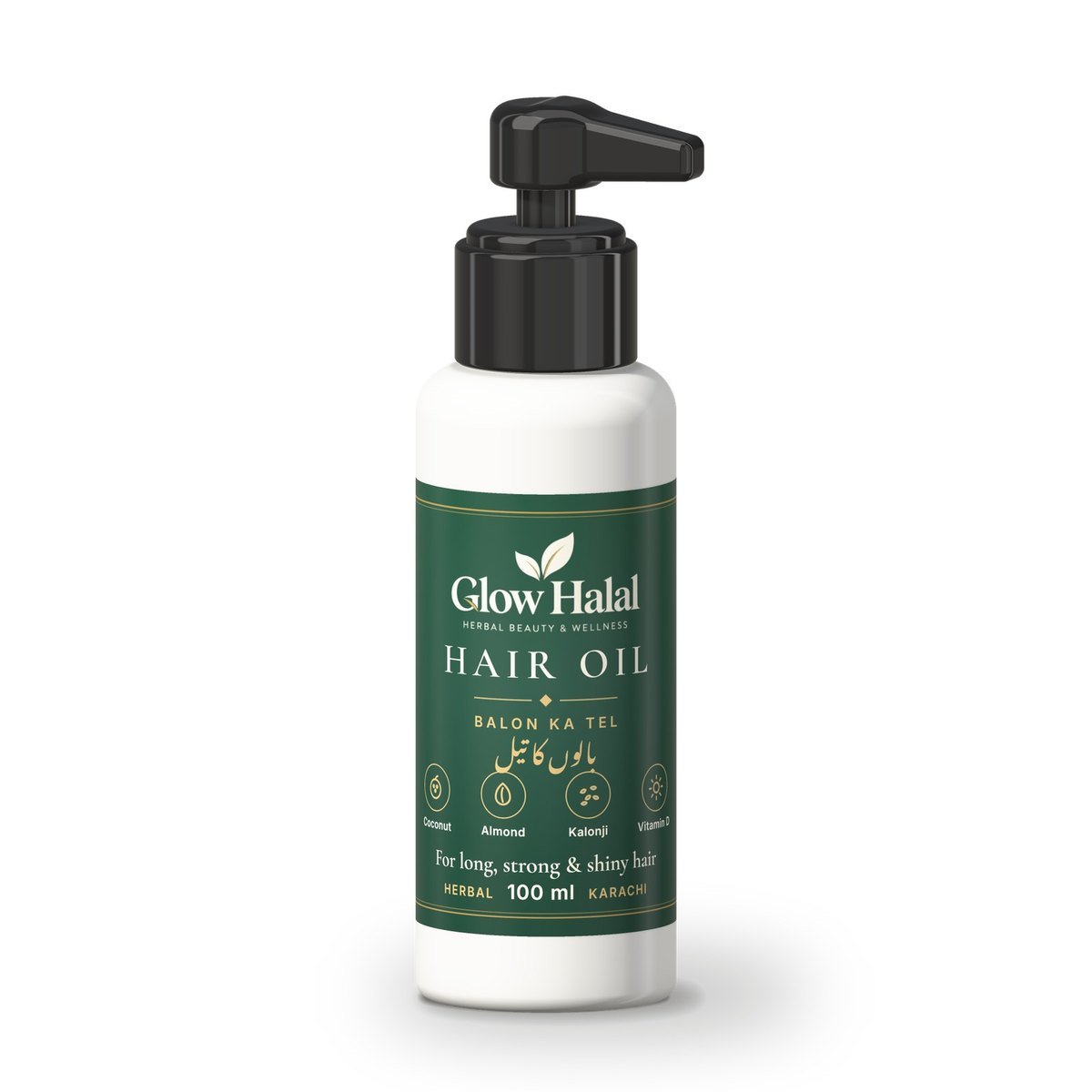
- A ready coconut–almond–kalonji blend: Glow Halal Hair Oil, online or on WhatsApp 0301 2973886, Cash on Delivery. Contains almond and coconut.
- Daraz: the widest choice, but counterfeits of popular brands are sold there — check the seller's rating, and see how to spot an original hair oil.
Eight popular hair oils, side by side: Best Hair Oil in Pakistan (2026): 8 Oils Compared.
Our oil
Glow Halal Hair Oil — Balon Ka Tel is a scalp oil, made for exactly this: a dry, flaky scalp. Four ingredients only: coconut oil, sweet almond oil (roghan-e-badam), kalonji oil and vitamin D. 100 ml Rs 1,200 · 200 ml Rs 2,000 · Cash on Delivery across Pakistan · Rs 300 delivery, free over Rs 5,000 · usually 2–4 working days to Karachi, Lahore, Islamabad, Rawalpindi and Faisalabad, 4–7 elsewhere. We work from Saddar, Karachi.
It is not for greasy, yellow flakes or a red, itchy scalp — use an anti-dandruff shampoo there. It contains almond (a tree nut) and coconut, so do not use it if you are allergic to either. Patch test on the inner arm first and wait 24 hours.
FAQ
Is coconut oil good for a dry scalp?
Yes, for most people, and it is cheap. Use a little, leave it 1–2 hours, and wash it out properly. For greasy, yellow flakes it is the wrong tool.
Should I oil a dry scalp every day?
No. Daily oil means daily shampoo, and daily shampoo is one of the causes of a dry scalp. Once or twice a week is enough.
Can I leave oil on my scalp overnight?
For a dry scalp in winter, yes, with an old towel on the pillow. Skip overnight oil if you get dandruff, forehead or back breakouts, or if the night is hot and humid.
Why is my scalp flaky only in winter?
Cold, dry air, gas heaters and hot head-washes. Lukewarm water, fewer shampoos and twice-weekly oiling usually settle it.
Does a dry scalp cause hair fall?
Dry scalp does not make hair fall from the root, but scratching can break hair. Hair coming out in clumps or patches needs a doctor, not an oil.
General information, not medical advice. A scalp that is red, painful, crusted or losing hair in patches needs a doctor.