A majoon (ma'jun) is a traditional Unani herbal paste: ground herbs stirred into a cooked honey or sugar syrup and eaten by the teaspoon. It is a food-type herbal preparation, not a medicine, usually taken at night with milk. It is mostly sugar, so people with diabetes should ask a doctor first.
What is majoon, in plain words
Majoon is a dosage form, not one recipe. In Unani tibb it belongs to the family of semi-solid preparations, alongside jawarish, itrifal and khamira. What they share is the method: herb powders held in a thick sweet base. The herbs depend on the maker, so two jars with "majoon" on the label can be completely different products.
How a majoon is made
The herbs are powdered, the sweet base is cooked into a syrup called qiwam, and the two are combined. A paper from the National Institute of Unani Medicine, Bengaluru, describes the method for a sister preparation that also contains saffron and mastic (CellMed, 2021):
- The herbs are cleaned, dried, ground to a fine powder and sieved.
- Honey or sugar is heated to make the qiwam, and the froth is skimmed off.
- The mixed powder is stirred into the syrup.
- Saffron is ground separately with rose water and added as a paste.
- Mastic is ground gently on its own, because it softens with heat, and goes in last with a little warm ghee.
The sweet base has a job. It binds the powders, helps preserve them, and makes bitter or pungent herbs easy to swallow.
Why majoon is taken at night with milk
This is tradition, not a research finding. Unani practice treats milk as a nourishing vehicle for tonic preparations, and bedtime is simply a settled time of day. We found no study showing that milk or night-time use changes the effect. So the honest wording is "traditionally taken with warm milk before bed", not "works better with milk". Water is fine if milk does not suit you.
Common herbs in a majoon, and what is known about them
Tradition is long; human research is uneven. These are the herbs Herbae names in its Majoon-e-Makhsoos.
| Herb | Traditional role | Human research |
|---|
| Safed musli (Chlorophytum borivilianum) | Strengthening tonic root | One small pilot trial (60 healthy adults, 3 g a day): longer walking and cycling distance than placebo. Early evidence only (PMID 31391682) |
| Kali musli (Curculigo orchioides) | Tonic rhizome | No human trials found |
| Zafran (saffron) | Uplifting, warming; used in small amounts | Trials of measured extracts (about 28 to 100 mg a day) on mood and sleep quality (sleep meta-analysis, 2022) |
| Mastagi roomi (mastic gum) | Settles the stomach | One trial in 148 people with indigestion, at about 1 g a day (PMID 19961914) |
| Long (clove) | Warming spice for digestion | Very little |
| Darchini (cinnamon) | Warming spice for digestion | Mixed results on blood sugar, in people with diabetes; the US NCCIH says research does not clearly support its use for any condition (NCCIH) |
| Mishri (rock sugar) | The sweet base | Chemically the same as table sugar |
The studies used known doses of single herbs. A teaspoon of majoon is mostly its sweet base, and makers rarely publish how many milligrams of each herb it holds. So a study on an ingredient is not a result for a jar.
Majoon benefits: what can honestly be said
A majoon is a traditional way to take tonic herbs as part of a daily routine. People use it for general energy, stamina and strength. That use rests mainly on tradition, with some early research on individual ingredients. A majoon that seems to act as fast as a tablet deserves suspicion, not praise.
How to take majoon
- Follow the jar. For Majoon-e-Makhsoos, Herbae's direction is 1 teaspoon daily, with water or milk, before going to bed.
- Do not double the amount hoping for more effect. You mostly double the sugar.
- Use a clean, dry spoon every time.
- Rinse or brush your teeth afterwards if you take it at bedtime. It is sweet.
- Stop if you notice any reaction, such as a rash, itching or an upset stomach.
How to choose a safe majoon
Buy the paperwork, not the promise. In July 2026 the Punjab drug testing laboratory found undeclared sildenafil, a prescription drug, in four unregistered herbal products, two of them majoons. None carried a maker's name or batch number (news report of the alert).
A safer jar has a named maker with an address, a batch number and expiry, a list of ingredients, a named and registered hakeem, and a dated lab report that names each drug it tested for. Our step-by-step guide: how to check a majoon for hidden drugs.
Sugar, diabetes and who should ask a doctor first
The biggest everyday caution with any majoon is sugar. Mishri is crystallised cane sugar, and there is no evidence it is healthier than ordinary sugar. The WHO advises keeping free sugars under 10% of daily energy, and says under 5% (about 25 g, roughly 6 teaspoons a day) brings extra benefit. A teaspoon of majoon uses part of that.
Ask a doctor before starting a majoon if you:
- have diabetes or pre-diabetes;
- take blood thinners (clove, and saffron in large amounts, may matter here);
- take heart or blood pressure medicines;
- have liver or kidney problems (cassia cinnamon contains coumarin);
- have an allergy to any listed ingredient;
- are under 18, or take any regular medicine.
How to store majoon
Keep it closed, cool and dry, and go by the expiry date printed on the jar. Close the lid tightly after each use, keep the jar away from sunlight, and never put a wet spoon in it. Throw it away if you see mould, or notice a fermented smell or a changed taste.
When tiredness needs a doctor, not a majoon
If you have felt tired for more than a few weeks without a clear reason, get a check-up first. No herb fixes tiredness that has a medical cause.
Low vitamin D is one example, and it is very common here. A meta-analysis of South Asian adults put vitamin D deficiency in Pakistan at 73%, the highest of the five countries studied (PMID 34627207). A simple blood test checks it. Doctors also routinely look at blood count, sugar and thyroid in a tired patient. The NHS adds: see a doctor if tiredness affects daily life or comes with weight loss or mood changes.
Where Majoon-e-Makhsoos fits
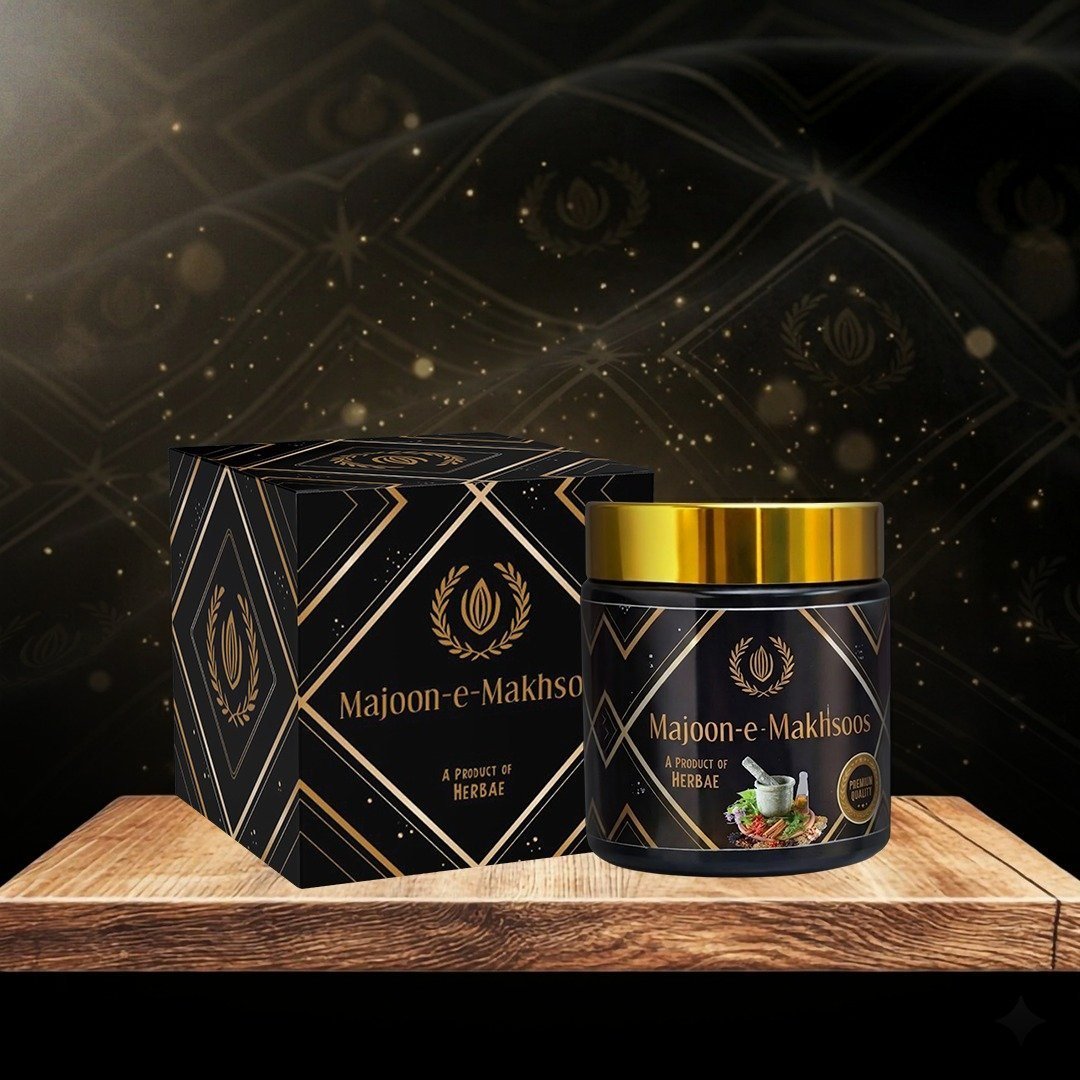
Majoon-e-Makhsoos is made by Herbae, a Pakistani herbal brand, and sold by Glow Halal in Herbae's sealed jar. We do not make it. Herbae names seven ingredients (the ones in the table above) and says there are "8+ more"; ask us on WhatsApp for a photo of the label if you want the full list.
PCSIR Laboratories Complex, Karachi tested one sample by TLC analysis and did not detect any of six hidden drugs it looked for: cortisone acetate, hydrocortisone, testosterone undecanoate, mesterolone, sildenafil citrate and tadalafil (Test Report # ILD/ATR-2026-47218, issued 15 June 2026). That is one sample of one batch, and a lab result rather than a regulator's approval.
FAQ
What is majoon made of?
Finely powdered herbs mixed into a cooked syrup of honey or sugar, called qiwam. The herbs vary from one majoon to another, so always read the label.
Is majoon a medicine?
No. It is a traditional herbal food-type preparation. It is not meant to diagnose or treat any disease and does not replace prescribed treatment.
How do you take majoon, and can I use water instead of milk?
Follow the jar; a teaspoon a day is typical. Milk at night is custom. Water is fine.
Can people with diabetes take majoon?
Only after asking their doctor. A majoon is largely sugar or honey and should be counted as sugar.
Does majoon have side effects?
It can. Sugar is the main issue, and any herb can cause an allergy or clash with a medicine. Stop if you react, and tell your doctor what you are taking.
To order: Majoon-e-Makhsoos is Rs 5,199 with free delivery and Cash on Delivery across Pakistan, usually 2–4 working days to the main cities. Questions first? Message WhatsApp 0301 2973886.
General information, not medical advice. A majoon is not a medicine. If you have a health condition or take regular medicines, ask your doctor before using it.